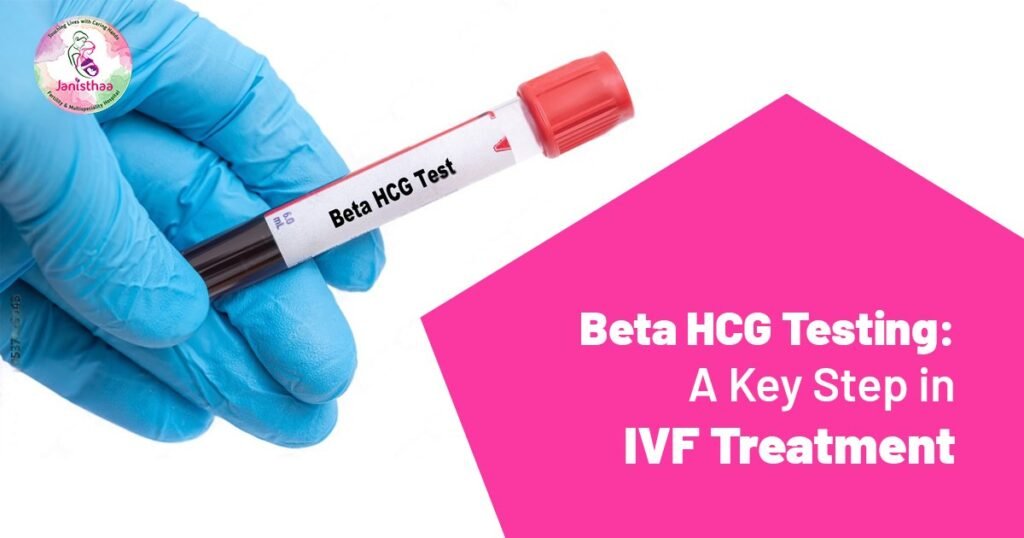
A beta hCG level above 100 mIU/mL at 10–14 days after embryo transfer is generally considered a positive result. The most important factor is not the initial number but whether it doubles every 48–72 hours. Fresh and frozen embryo transfer hCG levels differ slightly. At Janisthaa IVF Bangalore, the beta hCG test and repeat confirmation are included in your standard IVF monitoring.
After an embryo transfer, the beta hCG blood test is the moment everything changes. Whether you are reading this while waiting for your result, trying to understand a number you just received, or preparing for your first test — this guide covers everything an IVF patient at Janisthaa IVF Center Bangalore needs to know about beta hCG.
What Is Beta hCG and Why Does It Matter in IVF?
Human chorionic gonadotropin (hCG) — commonly called “the pregnancy hormone” — is produced by the trophoblast cells that surround the early embryo and eventually form the placenta. It is only produced when a pregnancy exists.
In IVF, because we know the exact day of embryo transfer, beta hCG testing is more precise and meaningful than in natural pregnancy. The quantitative blood beta hCG test measures the exact amount of hCG in your bloodstream in milli-international units per millilitre (mIU/mL).
What hCG does in early pregnancy
- Signals to the body that pregnancy has occurred — suppresses the next menstrual period
- Maintains the corpus luteum, which produces progesterone to support the pregnancy
- Stimulates production of oestrogen and progesterone during the first trimester
- Thickens and maintains the uterine lining for the growing embryo
- Rises rapidly in early pregnancy, peaks at 8–11 weeks, then gradually decreases
Day-by-Day Beta hCG Levels After Embryo Transfer
The table below refers to Day-5 blastocyst transfer (most common in modern IVF). Values are ranges based on published clinical data — individual results vary.
| Days After Transfer | Approximate hCG Range (mIU/mL) | Result Interpretation | What to Do |
|---|---|---|---|
| Day 5–7 | 0 – 10 | Too early to test reliably | Do not test — inconclusive results cause unnecessary anxiety |
| Day 8 | 3 – 18 | Very early — borderline | Avoid testing. Fresh cycle: trigger shot may still give false positive |
| Day 9–10 | 12 – 50 | Potentially positive — early | Repeat in 48 hours. FET cycles: this is now reliable |
| Day 11–12 | 50 – 100 | Positive — confirm with repeat | Repeat test at Day 14 to confirm doubling |
| Day 13–14 ⭐ | 100 – 300 | ✅ Strong positive | Excellent — schedule 6-week ultrasound |
| Day 14 (high) | 300 – 600+ | ✅ Very strong positive | Consider possibility of twins — ultrasound will confirm |
| <5 mIU/mL | Negative | ❌ Implantation did not occur | Contact clinic — stop progesterone as instructed, arrange review |
| 5–25 mIU/mL | Borderline | ⚠️ Requires repeat in 48 hours | Do not stop medications. Repeat hCG test in 48 hours |
Fresh vs Frozen Embryo Transfer — hCG Level Differences
hCG levels and testing timing differ between fresh IVF cycles and frozen embryo transfer (FET) cycles. Understanding this prevents confusion and false results.
| Factor | Fresh Embryo Transfer | Frozen Embryo Transfer (FET) |
|---|---|---|
| Trigger shot used? | Yes — hCG trigger injection for ovulation | No — trigger not used in FET cycles |
| Risk of false positive | Yes — trigger shot hCG takes ~10 days to clear | No — any detected hCG is from the pregnancy |
| Earliest reliable test | Day 10–14 post-transfer | Day 9 onwards (more reliable earlier) |
| Typical hCG levels | May be inflated early due to trigger remnants | Often slightly higher from Day 9 — FET embryos may implant earlier |
| Doubling pattern | Doubling every 48–72 hours after Day 10 | Doubling every 48–72 hours from Day 9 onwards |
| Reference ranges | Use Day 14 values as primary reference | Reliable from Day 9; Day 12–14 values for confirmation |
What Does My Beta hCG Number Actually Mean?
Patients frequently ask: “My hCG is 85 — is that good?” The answer is: it depends on when you tested, whether it is rising, and what your next test shows. Here is a framework for understanding your result:
Strong positive signs
hCG above 100 mIU/mL at Day 14 | Doubling every 48–72 hours | Level above 200 at Day 14 | Rising steadily over serial tests
Monitor closely — may still be okay
hCG between 25–100 mIU/mL at Day 12–14 | Rising but slower than doubling | Borderline levels that were very low initially | Low initial number in a patient who tested early
Requires urgent review
hCG below 5 mIU/mL (negative) | Falling or plateauing hCG across serial tests | Very slow rise (less than 50% increase over 48 hours) | Asymmetric symptoms with rising hCG (could indicate ectopic)
Beta hCG levels by weeks of pregnancy (reference)
| Gestational Week | Typical hCG Range (mIU/mL) | Notes |
|---|---|---|
| 3 weeks (implantation) | 5 – 50 | Just after implantation — levels very low |
| 4 weeks | 50 – 500 | Rising rapidly — confirms implantation |
| 5 weeks | 500 – 5,000 | First ultrasound timing (gestational sac visible) |
| 6 weeks | 1,000 – 50,000 | Heartbeat usually visible on ultrasound |
| 7–8 weeks | 10,000 – 100,000 | Peak of hCG production approaching |
| 8–11 weeks | 25,000 – 288,000 | hCG peaks — then begins to decline |
| 12–16 weeks | Declining gradually | Normal — placenta takes over progesterone production |
What If Beta hCG Is Not Doubling? — What It Means & What to Do
One of the most distressing situations for IVF patients is finding that hCG is rising but not doubling as expected. Here is an honest, compassionate explanation of what this may mean:
| hCG Pattern | What It May Indicate | What Your Doctor Will Do |
|---|---|---|
| Doubling every 48 hours or less | Healthy, progressing pregnancy | Schedule 6-week ultrasound |
| Doubling every 48–72 hours | Normal — pregnancy progressing well | Continue monitoring, schedule ultrasound |
| Rising but less than 60% increase in 48 hours | Slow rise — may be early pregnancy loss, or occasionally a viable but slow-starter | Repeat hCG every 48 hours; early ultrasound |
| Plateauing (not rising significantly) | Likely early pregnancy loss or ectopic pregnancy | Urgent ultrasound to rule out ectopic; discuss management |
| Declining (falling levels) | Pregnancy is not continuing (chemical pregnancy or early miscarriage) | Stop progesterone as directed; review consultation; plan next cycle |
Twins vs Singleton — hCG Level Differences After IVF
A common question after a high beta hCG result: “Does this mean twins?” The answer is: possibly, but an ultrasound is the only way to confirm.
| Pregnancy Type | Typical Day 14 hCG | How to Confirm |
|---|---|---|
| Singleton (one baby) | 100 – 300 mIU/mL | 6–7 week ultrasound — one gestational sac |
| Twins (two babies) | 300 – 600+ mIU/mL (30–100% higher than singleton) | 6–7 week ultrasound — two gestational sacs and two heartbeats |
| Triplets | Often 2–3× higher than singleton | Ultrasound confirmation essential — triplet pregnancies require specialist management |
When to Take the Beta hCG Test — and What to Avoid
| Scenario | Recommended Timing | Reason |
|---|---|---|
| Day-5 blastocyst (fresh IVF cycle) | Day 10–14 post-transfer | Trigger shot clears by Day 10 — reliable from here |
| Day-3 embryo (fresh IVF cycle) | Day 12–16 post-transfer | Slightly later implantation — wait for reliable levels |
| Frozen embryo transfer (FET) | Day 9–14 post-transfer | No trigger shot — reliable from Day 9 onwards |
| IUI cycle | 14 days after IUI | Allow full 2-week wait for accurate result |
| Natural conception | After missed period (Day 28–30 of cycle) | Blood test for early confirmation when urine test unclear |
Home urine test vs blood beta hCG test
| Factor | Home Urine Test | Blood Beta hCG Test |
|---|---|---|
| Sensitivity | 25 mIU/mL (standard) or 10 mIU/mL (sensitive) | Detects from 1–2 mIU/mL |
| Quantitative result | No — positive or negative only | Yes — exact mIU/mL level reported |
| False positive risk (fresh IVF) | High before Day 10 (trigger shot) | Lower after Day 10 when trigger has cleared |
| Recommended for IVF confirmation | Supplementary only | Yes — primary method at Janisthaa |
| Monitors pregnancy progression | No | Yes — serial tests every 48 hours |
Beta hCG Test Cost in Bangalore 2026
| Test Type | Cost at Diagnostic Labs | At Janisthaa IVF |
|---|---|---|
| Quantitative beta hCG (single test) | ₹400 – ₹800 | Included in IVF monitoring protocol |
| Serial beta hCG (repeat at 48 hours) | ₹800 – ₹1,600 (two tests) | Included — both tests are part of standard post-transfer care |
| Beta hCG with full hormonal panel | ₹1,500 – ₹3,000 | Available on request — discuss with Dr. Shwetha |
Dr. Shwetha Y Baratikkae — on interpreting beta hCG results
“The number you see on your beta hCG report is only part of the story. Over 15 years of IVF practice, I have seen patients with a Day 14 hCG of 45 go on to deliver healthy babies, and patients with levels of 250 face early losses. What matters most is the trend — is it rising? Is it doubling? That is why I review every patient’s result personally and ensure the repeat test is done at exactly the right time interval. No patient at Janisthaa receives a number without context and a conversation.”
20+ years experience | Janisthaa IVF — Basaveshwar Nagar, RR Nagar & Malleshwaram, Bangalore
What Happens After the Beta hCG Test?
| Result | Next Steps |
|---|---|
| ✅ Positive (hCG >100 at Day 14) | Repeat hCG in 48 hours to confirm doubling → Schedule 6-week ultrasound → Continue progesterone medications → Begin early pregnancy monitoring |
| ⚠️ Low positive (hCG 25–100) | Repeat hCG in 48 hours → Monitor trend → Continue all medications → Dr. Shwetha review — do not stop medications without guidance |
| ❌ Negative (hCG <5) | Stop progesterone and oestrogen as directed by doctor → Book a review consultation with Dr. Shwetha → Discuss next steps — frozen embryo transfer or new cycle |
Waiting for your beta hCG result? Talk to us.
At Janisthaa IVF Bangalore, Dr. Shwetha personally reviews every post-transfer result and is available to answer your questions.
Related reading
Frequently Asked Questions About Beta hCG After IVF
1. What is the normal beta hCG level 14 days after embryo transfer?
A normal beta hCG level 14 days after a Day-5 blastocyst transfer is typically above 100 mIU/mL. Levels above 200 mIU/mL are linked to a higher chance of an ongoing pregnancy, while levels above 600 may suggest twins. Below 5 mIU/mL is considered negative.
2. How fast should beta hCG double after embryo transfer?
Beta hCG should double approximately every 48–72 hours in early pregnancy. A rise of at least 60% over 48 hours is generally acceptable, while faster doubling is a strong positive sign.
3. What does it mean if beta hCG is not doubling after IVF?
Slow-rising hCG levels may indicate a failing pregnancy, ectopic pregnancy, or sometimes a slow-developing but viable pregnancy. Follow-up tests and ultrasound are required for confirmation.
4. What beta hCG level indicates twins after IVF?
A beta hCG above 600 mIU/mL at Day 14 may suggest twins, as twin pregnancies often produce higher hormone levels. However, only an ultrasound can confirm this.
5. When should I do the beta hCG test after embryo transfer?
For a Day-5 transfer, testing is recommended between Day 10–14. For frozen embryo transfer (FET), reliable results can be obtained from Day 9 onwards.
6. Is a beta hCG of 5 mIU/mL positive after IVF?
A level of 5 mIU/mL is borderline. Most clinics consider levels above 25 mIU/mL as clearly positive. Repeat testing after 48 hours is recommended.
7. What is the difference in hCG levels between fresh and frozen embryo transfer?
In FET cycles, hCG detected is from pregnancy only (no trigger shot interference). Fresh cycles may show false positives before Day 10 due to medication.
8. What is the cost of beta hCG test in Bangalore?
A beta hCG blood test typically costs ₹400–800 at diagnostic labs in Bangalore. Many IVF clinics include this in their treatment package.
9. Can I do a home pregnancy test instead of the beta hCG blood test?
Home pregnancy tests are not recommended after IVF as they are not quantitative and may give false results. A blood test is the most accurate method.
10. What happens if my beta hCG test is negative after IVF?
A negative result means the embryo did not implant in this cycle. You will usually be advised to stop progesterone and oestrogen medications as directed by your doctor. It is important to schedule a follow-up consultation to review the cycle and discuss next steps, such as a frozen embryo transfer (if embryos are available) or planning a new IVF cycle. Even a failed cycle provides valuable insights to improve future success.